Social History
We are very aware of the social history of the community held within the churchyard and are keen to ensure that this history is not lost. We note the number of surnames which prominently feature such as: Anderson, Browning, Fisher, Fleet, Goodban, Goodwin, Kennett, Marsh, Newman, Price, Ratcliffe, Taylor, Wallis and Wood.
But before we look at some individual families we have material, here, about events during the time of the Swing Riots (1830/31) and the impact they had on the village of Blean.
Were your ancestors Swing Rioters? Read on for details of the Packman brothers, buried in Blean Churchyard after having been brought from the gallows at Penenden Heath, Maidstone (by Susan Green)
There are certain dates, 1066, 1815, 1914-1918 or 1939-1945, which stick in the mind, but for those of us with Kentish ‘Ag.lab’ ancestors then 1830-1831 should be added to the list. These dates mark dark and difficult times for the labourers and working men of Kent, their families and communities. During this time the county bore witness to unprecedented levels of social disorder and protest leading the government of the day to impose harsh justice on the labouring classes. These disturbances became known as ‘The Swing Riots’.
Hardly a community or labouring family escaped the impact of these turbulent events. Beginning in East Kent, the protests spread across the whole county and soon extended across the agricultural regions of the south and east of England. Parts of Lincolnshire, Nottinghamshire and Yorkshire would see protests too. Not since the rising of Wat Tyler and the Peasant’s Revolt in 1381, had the labourers of this county and beyond risen in such numbers, yet their actions and protests have slipped from the collective memory. With the bicentennial of their actions almost upon us perhaps it’s time to correct this, by asking was your ancestor a Swing Rioter? … and if so, bring their story to life.
Like many people I admit I was totally ignorant of the course of events which unfolded near Canterbury in August 1830 or the consequences they would have. Whilst researching the Tolpuddle Martyrs for my Zoom history group during lockdown, reference was made to The Swing Riots explaining that they had happened prior to the actions taken by those pioneering Dorset men. What drew my attention, however, was the fact that these events began in Kent. With family roots going back centuries in Kent, I was curious as to why I knew nothing about them. An internet search took me to a blog on the University of Kent’s website entitled The Age of Revolution, which mentioned the death and execution of two young brothers, William and Henry Packman, aged 20 and 18 respectively from the Blean area near Canterbury. This pricked my interest further, my 4x great grandmother was Mary Packman born 1798 in Boughton Under Blean. Further family research confirmed there was a connection between Mary and the two brothers, but little did I realise where this initial connection would lead me and the story which would unfold. It would be a David and Golioth tale with acts of desperation, betrayals, anguish and loss.
Nestling in the Blean countryside is the ancient church, of St Cosmos and St Damian. Its peaceful graveyard is the final resting place of the two brothers, as recorded in the burial register which also confirmed the darker secret which had lain hidden for generations. Annotated in the margin recording their burial on 28th December 1830 the vicar has noted:
Executed at Penendon Heath for Arson
The background to their tragic fate was complicated and far, far bigger than the two young lads could have imagined as they got caught up in a national story which the government had every intention of controlling.
A number of significant societal events and deeply rooted grievances came together creating a perfect storm for our agricultural ancestors in 1830-31. The long years of war against Napoleon was followed by an acute economic slump and chronic unemployment. The Corn Laws had kept bread prices high made all the worse by a series of poor harvests. The long-term effect of Enclosures was biting hard on the labouring communities, reducing the agricultural workers to “landless” labourers losing all rights to the common land.
The brutal consequences of this were exposed by William Cobbett when he visited the Isle of Thanet in the Autumn of 1824 he wrote:
“The labourer’s houses… are beggarly in the extreme. The people dirty poor looking; ragged but particularly dirty. The men and boys with dirty faces, and dirty smocks and dirty shirts…the more purely a corn country, the more miserable the labourers. The cause is this, the great big bull frog grasps all. In this beautiful island every inch of land is appropriated by the rich. No hedges, no ditches, no commons, no grassy lanes: a country divided into great farms; a few trees surround the great farmhouse. All the rest is bare of trees; and the wretched labourer has not a stick of wood and has no place for a pig or cow to graze or even to lie down upon…It is impossible to have an idea of anything more miserable than the state of the labourers in this part of the country.” (Rural Rides Vol 1 1830)
Enclosing the land was exacerbated by the consequences of the Agricultural Revolution especially the introduction of farm machinery, particularly the threshing machine. Threshing provided the main winter work for the labourers. For the landowners and farmers these new machines made economic sense. The machines reduced the number of hands needed to be employed, saving the employers money. If labour was required, the wages offered was pitiful as unemployment increased and competition for jobs rose along with it. Reduced wages, unemployment and no common land to support them, led our ancestors to endure unimaginable hardships and deprivation as witnessed by Cobbett.
Following two particularly bad harvests in 1828 and 1829, enough was enough. With no political voice labourers resorted to civil disobedience. The first such event was on the night of 28th August 1830 saw the destruction of a threshing machine at Lower Hardress, near Canterbury.
Threatening letters began to be sent to farmers and landowners demanding higher wages and a stop to the use of threshing machines. The name Swing was added to the letter. This was the fictional leader Captain Swing, adopted by the protestors, and hence gave its name to the protests, The Swing Riots. If there was no response to the letter then groups of farm workers would gather breaking the hated machines and on occasion burning down hayricks and barns.
At first local magistrates showed leniency to those arrested for such offences. At the East Kent Quarter Sessions in October 1830 magistrates imposed a caution and a mere 3-day prison sentence on seven machine breakers. By the autumn such riotous offences had escalated dramatically, with more than 100 threshing machines being destroyed in East Kent. In the midst of the uprisings there was a change of Government, with Earl Grey forming a Whig government on 15th November 1830 and with the change of government came a change in approach to dealing with the disorder. Lord Melbourne became Home Secretary and bypassed the local magistrates, setting up instead a Special Commission of 3 Judges to try the rioters and to impose harsher sentences.
On the night of 21st November, just one week after the new government was elected, William and Henry Packman accompanied by a third youth, George Bishop, left the Red Lion Public House ( later to become the home of Oliver Postgate of Bagpus and Nogin the Nog fame ) and set fire to some straw stacks belonging to William Wright at Denstroud, Blean. The alarm was raised and despite the 3 youths helping to douse the flames, suspicion immediately fell on them being the perpetrators.
They were taken into custody the next day and charged. George Bishop, who according to reports was the instigator, turned King’s Evidence, giving evidence against the two brothers, which allowed him to walk free, whilst leaving his 2 accomplices to face the serious charges of arson – a capital offence.
Setting fires as a protest was not an uncommon action with another even set in Blean on the same night. However, communities remained tight lipped and no one, to use Henry Packman’s word ‘split’. This didn’t happen in this case as a number of other witnesses also gave evidence for the prosecution against the 3 youths. With the charges against Bishop being dropped the witness statements condemned William and Henry Packman to the ultimate price of the law and begs the question why should this be? Was it a particular dislike of the brothers or was there something else?
Perhaps it is no coincidence that at the same time His Majesty’s Proclamation dated 23rd November was initiated by Parliament. Its aim was to incentivize the public to ‘split’ on anyone suspected of machine breaking and setting fires. The Proclamation stated that ‘any person’, whose evidence brought such an offender to court was ‘entitled to the sum of Five Hundred Pounds for each and every person who shall be convicted’. In the case pertaining to the Packman brothers, it meant £1000, or a share of it, was the financial reward offered. Was this the motivation for witnesses ‘splitting’? Certainly, the sum of £1000 was referred to in George Bishop’s cross examination.
No witnesses were called for the brothers, who presented their defence in a written statement, protesting their innocence. Rex v Hy & Wm Packman was only going to have one verdict – Guilty. A newspaper report stated that after the Judge had done his summing up, ‘The jury deliberated for about five minutes and then retired to consider their verdict. After an absence of ten minutes returned the verdict…’ Guilty’
The jury did go on to state that in their opinion Bishop was the more guilty and should not receive any of the substantial financial reward offered. They also recommended that the Judge show mercy to the brothers.
However, the government was determined to regain control of the civil unrest which was now spreading across the land. It was no surprise therefore when Judge Bosanquet put on his black cap and handed down the death penalty to both brothers. The National Archives holds a series of documents recording what happened next. One document is a petition for mercy. It was signed by the village worthies, including the Vicar, the church wardens and had the mark X of the prosecuting farmer, Wm Wraight. (NA HO17/46/1)
The NA also holds correspondence between Judge Bosanquet and Lord Melbourne on this matter. (NA Ho17/46/1) One is annotated on the front stating an ‘example’ should be made. A fact picked up by the Warwick and Warwickshire General Advertiser who reported….
‘The fate of the Packman’s who are mere lads, excites a strong feeling in their favour, owing principally to their youth, and also to the circumstances of their having been found guilty through the evidence of an accomplice, who was, in fact the promoter of the act which they are to suffer. Under ordinary circumstances, it is probable that their sentence would be mitigated to transportation for life, but in the present state of the country it is considered that examples must be made…’
The whole trial was given national newspaper coverage, with the Packman boys being portrayed as lawless youths, who were poachers and smugglers with no regard for the rule of law or respect for the sabbath. Yes, they were poachers, they admitted to that, but then so were many labourers at the time, as well as many others who also turned their hand to smuggling along the Kent coast. The Maidstone Journal reported that ‘One of the brothers remarked… they generally spent their Sunday’s in the woods, catching squirrels. Those they took alive they sold, those they killed they ate… Not exactly the food of kings or their betters but a sad and pitiful admission highlighting once again the desperation of folk at the time.
The Packman brothers along with another man John Dyke,( also known as John Field,) and who’d also been convicted of arson, were taken in an open wagon to Penendon Heath, Maidstone for a public hanging. An armed guard of Scots Greys escorted the waggon for fear of an attempted rescue, as feelings were running high. The bodies of the brothers were taken back to Blean by their family who had witnessed the awful scene. Whilst John Dyke’s body was taken to Bearstead for burial. This was to be the last public hanging at Maidstone. Such grim sentences were in future carried out in the prison.
John Dyke had always protested his innocence, even on the scaffold but to no avail. His conviction and execution, however, has been shown to be an appalling miscarriages of justice. Later, a man called, Hewitt, who’d give evidence against John Dyke confessed on his deathbed that it was him and not John Dyke who had set fire to a haystack. A stone covering Dykes grave at Bearstead reads:
This Memorial
Marks the Grave
Of
John Dyke
Who was hanged for Rick Burning
In 1830 at the last public hanging
At Penenden Heath
Subsequently it was found
That He was not Guilty
Of the Crime
As for George Bishop he was last recorded as enlisting as a soldier and leaving the area. Nothing further is known. There is no record that he benefitted from any ‘reward’ money. As for the other witnesses whose evidence condemned the brothers, they put in claims for the substantial government reward of £1000. However, in another twist in the tale their claim was denied on the grounds that the arson offence was committed before the rewards scheme was active. The timing was out by one day. The correspondence continues and states the witnesses had received a share of a £500 reward which ‘they have already obtained from the Magistrates of the County.
This is certainly a sad and tragic tale and will have had enormous ramifications on the whole parish, shattering the lives and relationships of so many. Perhaps that explains how it has dropped out of the common memory as shame and bitterness must have been overwhelming.
This research wouldn’t have been possible without the meticulous work of Jill Chambers who has produced 2 volumes relating to the Swing Riots in Kent, entitled
‘Kent Machine Breakers
The Story of the 1830 Riots
Vol 1 The riots and Trials
Vol 2 The Rioters
They are the most remarkable and detailed sources, taken from newspaper reports and court documents. Jill has also produced equally detailed evidence for other counties who also experienced the Swing Riots and the trials which followed.
Jill’s sources have enabled me to compile a list of those brought before the courts in Kent, their offences, where and when they were tried and their sentences. It reveals 109 names in total, 4 of whom were executed. William and Henry Packman together with John Dyke, were the first in the country to receive such a fate, the fourth man from Kent was Richard Dixon from Eastry executed for Arson on 22nd December 1831. (23 men in total were executed nationally) 28 others from Kent were transported either for life or for 7 years. The consequences of these sentences are equally disturbing. Many men were married with children who were left destitute and ‘On the Parish’ after their husbands and fathers left these shores. Jill’s sources include detail records of those who were transported, often with a short biography of their lives, including a physical description of each ‘convict’ and will be of interest to those of Kent Ancestry in Australia.
In compiling the list, I have discovered another Swing Rioter in the family. Thomas Read bpt 10/10/1805 at St. John’s Church, Margate. He was convicted as a machine breaker and was transported unusually for life to Van Diemen’s Land (Tasmania) He was the brother of my 4x great grandfather William Read, bpt 2/5/1794 St John’s Margate. There is also another family link through a second marriage of my great grandfather. George Jarman of Margate b 1861, to William Hughes of Acol/Birchington transported for 7 years to NSW. Other family names have also turned up both on the ‘Rioters’ list, and the KFHS members surname interests list, eg Fagg and Pilcher. These need further research so there could be more! For those of you who are fans of ‘Who Do You Think You Are?’, may well recall that both Lesley Manville and Ed Balls have Swing Rioter ancestors too.
Like the Tolpuddle Martyrs the majority of Swing Rioters were pardoned in 1835, with those who were transported being granted Government Free Pardons in 1836 for the parts they had played in the Swing Riots. For the four Men of Kent executed for their parts there was no posthumous pardon. As the bicentennial approaches acknowledging them would be a fitting memorial. John Dyke does have a memorial, but the other 3 Men of Kent have nothing to record their burials and the part they played in the Swing Riots. The local community from the parish of Mickeldever in Hampshire have done just that for a young lad, Henry Cook who was caught up in the riots, executed and buried in an unmarked grave in their churchyard. They have erected a plaque to commemorate him which means his Swing Riot story is part of the heritage of their community. (See below)
Hampshire is being very proactive in promoting the Swing Riot story. The following are particularly interesting and locating in your search engine.
- The University of Winchester Swing Riots
- The English Project linked to above and has actively launched a website related to Swing Riots and have organised events and speakers
- Henry Cook and Mickeldever Parish Website
- The National Archives has a site dedicated to Swing Riots containing documents and examples of Swing Letters etc. Lesson plans for teachers too!
- University of Kent Age of Revolution
Perhaps your family or community has a Swing Riot story and now is the time to discover it and to recognise the struggles of 1830-31, whilst adding these dates to your list of memorable historical events.
Susan Green (16445)
What follows now is information about Blean families kindly proved by Mr Lester Clark, whose family has lived in the villages and supported the church for very many years. Hopefully we will be able to add other family details to the Social History Annexe as time goes by.
HENRY TAYLOR AND ROSE KIRBY
We are particularly fortunate to have been given details of Mr Henry Taylor, who had particular connections with the churchyard, as he was the Sexton for 54 years! It is right we take note of his history as his family still live in Blean.
Henry was born in Tyler Hill in 1888 and then moved to “Orchard House “in Chapel Lane, Blean with his parents William and Elizabeth Taylor (buried in the churchyard) and his brother Fred. He met Rose Kirby who lived with her parents at Honey Hill Farm, Blean (Frances and Thomas Kirby also buried in churchyard). Rose was a direct descendant of Nathaniel Kirby who moved to Blean and married Mary Pim in Blean Church on 17 May 1759.
Henry and Rose married in Blean Church in 1915 and lived in Chapel Lane all their lives.
Henry was “self employed” and did various jobs, mainly working in the woods making pit props (presumably for the Kent pits operating at the time), hedging, ditching, maintaining Blean Churchyard and grave digging. He was the Parish Clerk for 48 years. He took on the job of sexton when he was 22 and continued in that role until he was 76! He dug the graves of his and his wife’s parents next to each other so that at a later date he and Rose could be buried with their respective parents and remain together for ever.
He was a small, wiry man but very strong, which he needed to be bearing in mind the waterlogged clay nature of the churchyard. He cut the grass with a scythe until the early 1960s, when his daughter gave him a push mower. He never drove, but went around with his tools on the crossbar of his bicycle.
In addition Henry lit the church boilers, prepared the oil lamps and laid out the Communion table very early on Sundays. He then returned home for his sausage meat breakfast and then back to the church to ring the bell.
He sat in the single pew seat by the rear pillar to be ready to ring the bell again at the appropriate times during the service.
While Henry did all this Rose took over from her mother, Frances, as church cleaner. She kept the church spotless, including scrubbing the flagstone floor. The water came from a nearby pond in Church Cottage’s garden, except in the summer when the pond dried up and she had to fetch the water from the Sarre Penn, at the bottom of the valley. To dust the rafters Henry made her a long pole with feathers on the end. She also cleaned the brass and arranged the flowers.
When Henry gave up full time work and his church duties he continued to work part time until he was 82 when he was forced retire, when he fell off his bike and broke a hip. He continued to puff on his pipe, smoking “Hearts of Oak” and “Nut Brown” tobacco, until his death at 91. He and Rose are buried in the churchyard.
We are very grateful to Lester Clark, Henry’s Grandson, who lives in School Lane Blean, and his mother, for providing these details of church, and churchyard, life, which we are glad to help preserve. Henry’s Great Granddaughter, Shelley Clark, was married in Blean Church in recent years. This wonderful family story continues……!
THE TRUEMANS OF OAKWELL
The Truema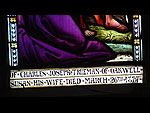 ns of Oakwell, and their descendants, have featured greatly in the life of Blean Church. The house of “Oakwell in the Blean”, in Tyler Hill, has always been within the boundary of the Parish of St Cosmus and St Damian in the Blean, even when most of Tyler Hill was in the Parish of St Stephens. ns of Oakwell, and their descendants, have featured greatly in the life of Blean Church. The house of “Oakwell in the Blean”, in Tyler Hill, has always been within the boundary of the Parish of St Cosmus and St Damian in the Blean, even when most of Tyler Hill was in the Parish of St Stephens.
Charles Joseph Trueman was born in London in 1810 and served in the 6th Dragoons( Carabiniers). In 1838 he married Penelope Susan Hamilton, the daughter of the Revd James Hamilton, the then Rector of St Stephens. She was born in 1818.
Oakwell, which was built in about 1836, was given to them as a wedding present!
Charles and Penelope Susan had a son and two daughters:
Charles Hamilton born in 1839, Florence Augusta born in 1844 and died in 1897, Alicia Matilda born in 1846 and died in 1919
Penelope Susan died at Oakwell in 1877 and Charles Joseph died in 1880. They are buried next to each other in the “Old” churchyard to the South of the chancel. The West stained glass window of the church was commissioned in memory of them and has been refurbished recently with the kind help of the family. Florence Augusta is buried next to her parents.
Oakwell was inherited by Charles Hamilton Trueman. He joined the army and served in 32nd Light Infantry Regiment. He married Dorothea Magdelene Fitzgerald, younger daughter of Dr JP Fitzgerald MD of South Africa in 1874. Charles Hamilton and Dorothea Magdalene had a daughter and four sons: Mary Penelope Florence born in 1875, Charles Fitzgerald Hamilton born in 1877, Henry John Hamilton born in 1878, Arthur Philip Hamilton born in 1880, James Fitzgerald Hamilton born in 1884.
Mary Penelope Florence married John Hayward Taylor Gornall, who had served in the Royal Artillery in the Great War, in 1922 and died childless in 1946.
In 1914 the tragedy of the 1st World War struck the family when Charles Fitzgerald, then a Captain in the Manchester Regiment, who had previously served in the Boer War, was killed in the battle of Le Cateau. The shock of this may well have caused the death of his mother. He is listed on the 1st World War Memorial in the church. He is buried in the Le Cateau Military Cemetery.
Henry John became a major serving in the 43rd Erinpura Regiment of the Indian Army and served during the Great War in Mesopotamia, twice being mentioned in despatches..
Arthur Philip joined the East Kent Regiment “The Buffs” and served in the Boer War. He married Violet Elizabeth Bews. He reached the rank of Lt Col and was awarded the OBE. He was wounded in action in the Great War and was invalided back to England. Both he and his wife died in the great flu’ epidemic of 1918. He is listed on the 1st World War Memorial in the church. He was buried in Mansfield Cemetery
James Fitzgerald died unmarried in 1951. Dorothea Magdelene died in 1914 and Charles Hamilton in1917.
Because of the death of his elder brother Charles Fitzgerald in 1914 Henry John inherited Oakwell on the death of his father in 1917.
Henry John married Margery Norman Wightwick on 2nd September 1911 and in 1914 they had a daughter, Jean Hamilton. She was their only child. John Henry died in 1922 and there is a memorial to him by the back gate of the churchyard. Margery Norman lived at Oakwell until her death on 28th January 1951. She was the last person bearing the name of Trueman to live at Oakwell.
Her daughter Jean Hamilton married Lt Cmdr Rodolf Cecil Drummond Haig, only son of Mr and Mrs Cecil Haig of the Chase, Monnington – on - Wye, Herefordshire, in the nave of Canterbury Cathedral, on 29th June 1935. Jean Hamilton and her husband moved to Oakwell in 1953. Her uncle James Fitzgerald had acted as a trustee of Oakwell in 1951 and 1952. Jean and Rodolf were both very much involved with the church. Jean and Rodolf had two daughters:
Penelope Susan. Born on 23 August 1938, Elizabeth Anne. Born on 26 September 1945
Penelope Susan married George Shetliffe of Hereford on 27 February 1960 and Elizabeth Anne married Lt John Colin Caverhill, of the Royal Scots (the Royal Regiment), the First Regiment of Foot, on 25 February 1967 in the church. Rodolf Haig died in May 1981.
The pattern and chalice usually used at the Eucharist were presented to the church in memory of him. Jean Haig (nee Trueman) died on 16 March 1988. The processional cross was presented to the church in her memory. The two daughters inherited Oakwell. Elizabeth and Colin moved to Oakwell in 1990 and the ownership fell to Elizabeth in 1991. Colin retired from the Army in the rank of Lt Col in 1993. Elizabeth died on 20 January 2004 and many donations kindly given at the time of her death helped with the costs of the reordering of the church. Colin inherited Oakwell on her death.
Elizabeth and Colin had four daughters:
Lucy Helen. Born on 27 January 1969 in Penang, Malaysia and married in the church on 25 February 1996 to Henry Rymill of Adelaide, Australia. Charlotte Louise. Born on 3 November 1970 in Penang, Malaysia and married in the church on 7 July 2001 to Adrian Downing of London. Sarah Eleanor Jean. Born on 22 January 1981 in Salisbury. Katherine Anne. Born on 29 July 1983 in Edinburgh.
We thank the Truemans for the link between Oakwell and the church lasting 170 years.
|